
“匡时杰出学者”系列讲座
演讲题目
主讲人
陈 晖
Nomura Professor of Finance at the MIT Sloan School of Management
Research Associate at the National Bureau of Economic Research
联合主办单位



时间
参会链接
腾讯会议:735-274-068
主讲人简介

Hui Chen is the Nomura Professor of Finance at the MIT Sloan School of Management and a Research Associate at the National Bureau of Economic Research. His research interests include asset pricing and its connections with corporate finance, liquidity risks, as well as financial machine learning. In recent projects, he proposes firm-level measures of segmentation between the equity and debt markets, which helps locate mispricing in both markets. He has also been studying how to integrate machine learning methods into finance more effectively and is building a suite of modern “lookup tables” for workhorse models in finance and economics using deep neural networks. Chen is the co-editor of the Annual Review of Financial Economics. He was editor of the Review of Asset Pricing Studies, and associate editor for the Journal of Finance, Review of Financial Studies, Journal of Banking and Finance, and Management Science. He is the recipient of the Journal of Finance Smith Breeden Prize and Dimensional Fund Advisors Prize, among other scholarly awards. He holds a Ph.D. in Finance from the University of Chicago.
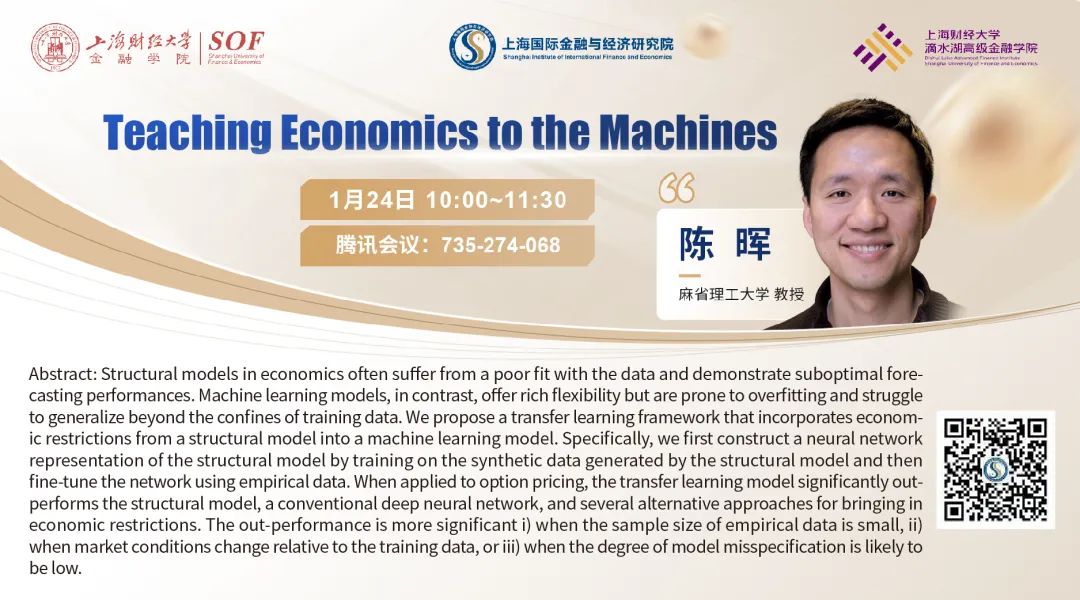
题目:Teaching Economics to the Machines
摘要:Structural models in economics often suffer from a poor fit with the data and demonstrate suboptimal forecasting performances. Machine learning models, in contrast, offer rich flexibility but are prone to overfitting and struggle to generalize beyond the confines of training data. We propose a transfer learning framework that incorporates economic restrictions from a structural model into a machine learning model. Specifically, we first construct a neural network representation of the structural model by training on the synthetic data generated by the structural model and then fine-tune the network using empirical data. When applied to option pricing, the transfer learning model significantly outperforms the structural model, a conventional deep neural network, and several alternative approaches for bringing in economic restrictions. The out-performance is more significant i) when the sample size of empirical data is small, ii) when market conditions change relative to the training data, or iii) when the degree of model misspecification is likely to be low.