
点击蓝字 · 关注我们

近期,我院杨金强教授、牛英杰助教授与合作者的论文“Disaster learning and aggregate investment” 发表在经济学权威期刊 Journal of Economic Theory 上。在线资源请点击“阅读原文”获取链接。
论文简介
论文题目:Disaster learning and aggregate investment
论文作者:Yingjie Niu (牛英杰,上海财经大学),Jinqiang Yang(杨金强,上海财经大学),Zhentao Zou (邹镇涛,武汉大学)
发表期刊:Journal of Economic Theory
英文摘要:
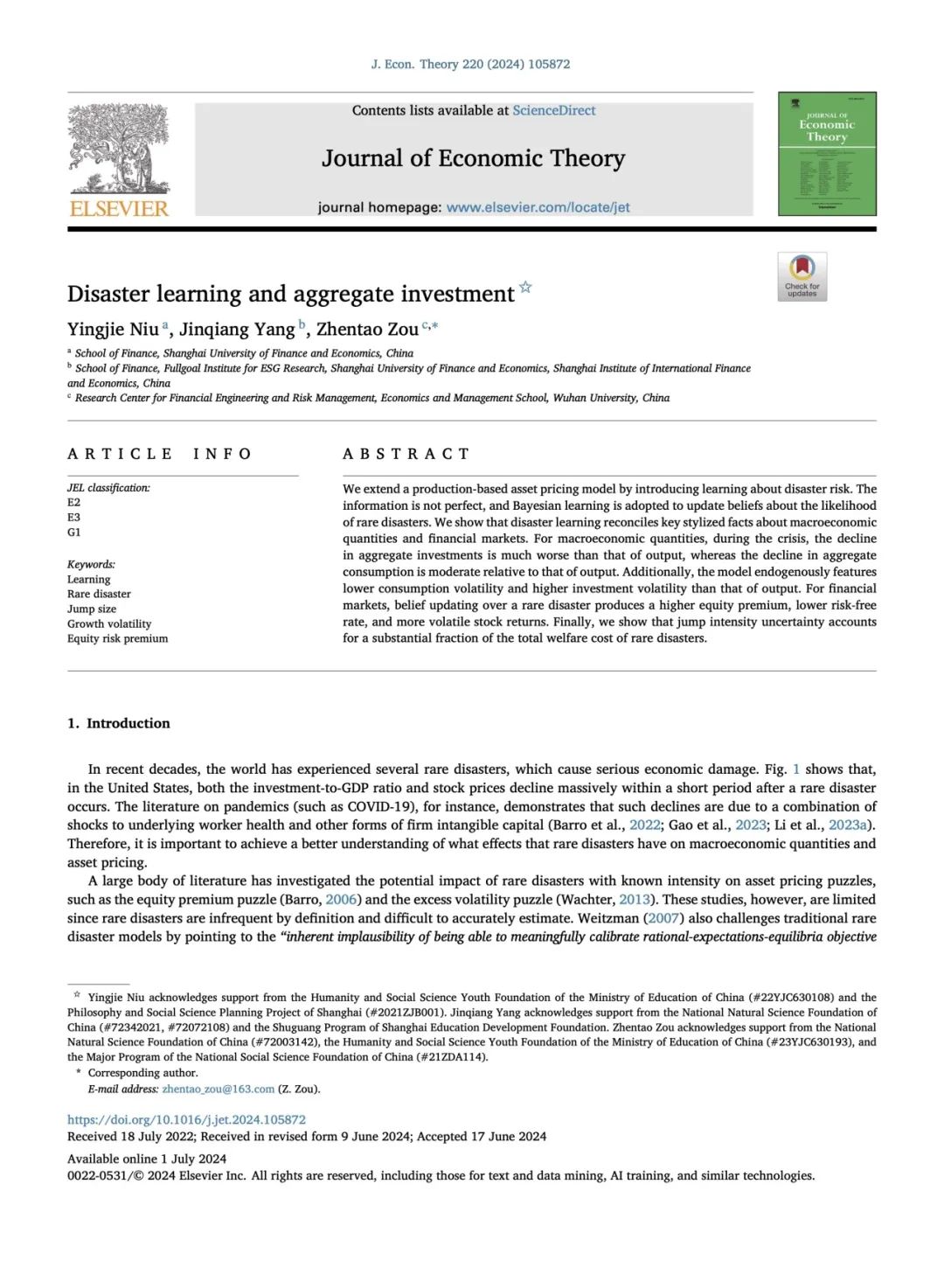
We extend a production-based asset pricing model by introducing learning about disaster risk. The information is not perfect, and Bayesian learning is adopted to update beliefs about the likelihood of rare disasters. We show that disaster learning reconciles key stylized facts about macroeconomic quantities and financial markets. For macroeconomic quantities, during the crisis, the decline in aggregate investments is much worse than that of output, whereas the decline in aggregate consumption is moderate relative to that of output. Additionally, the model endogenously features lower consumption volatility and higher investment volatility than that of output. For financial markets, belief updating over a rare disaster produces a higher equity premium, lower risk-free rate, and more volatile stock returns. Finally, we show that jump intensity uncertainty accounts for a substantial fraction of the total welfare cost of rare disasters.
中文摘要:
该研究在基于生产的资产定价模型基础上进行了拓展,引入了对灾难风险的学习机制。由于信息并非完美,所以采用贝叶斯学习来更新对罕见灾难发生可能性的信念。研究表明,通过引入对灾难风险的学习机制,该模型能够使宏观经济数量和金融市场相关的关键典型化事实相协调。从宏观经济数量角度来看,在危机期间,总投资的下降幅度远大于产出的下降幅度,而总消费的下降相对于产出而言较为温和。同时,模型内生地呈现出消费波动性低于产出,投资波动性高于产出的特征。从金融市场角度来说,对罕见灾难可能性信念的更新会导致较高的股权溢价和较低的无风险利率,并造成更具波动性的股票回报。此外,研究结果显示跳跃强度不确定性在罕见灾难的总福利成本中占相当大的一部分,这意味着对灾难风险的不确定性给经济主体带来了显著的福利损失。
期刊简介
Journal of Economic Theory
Journal of Economic Theory 创刊于1969年,是理论经济学领域的国际顶级期刊,也是国际经济学界公认的九种核心期刊之一,其刊登论文主题包括机制设计、决策理论、博弈论、货币经济学等。根据Web of Science 2022年的JCR数据,该刊影响因子为1.79。
作者简介