
近期,我院弓晓敏老师与合作者的论文 Dynamic portfolio allocation for financial markets: A perspective of competitive-cum-compensatory strategy 发表在我校认定的国际A级期刊 Journal of International Financial Markets Institutions & Money(简称“J INT FINANC MARK”)上。在线资源请点击“阅读原文”获取链接。
Dynamic portfolio allocation for financial markets: A perspective of competitive-cum-compensatory strategy
Cheng Zhang a, Xiaomin Gong b, Jingshu Zhang c, Zhiwei Chen
Journal of International Financial Markets Institutions & Money, publishied online.
Journal of International Financial Markets Institutions & Money

《货币经济学杂志》(Journal of International Financial Markets Institutions & Money)是经济学领域的核心期刊之一,每年出版十次,文章涵盖了对广泛现代宏观经济主题的重要研究贡献,包括经验、方法和理论方面的研究成果,该期刊最近五年影响因子为4.755。

弓晓敏
弓晓敏
新聘研究员, 已在Journal of International Financial Markets, Institutions & Money, International Review of Economics and Finance, Expert Systems with Applications, Applied Soft Computing, Computers & Industrial Engineering 等国际SSCI和SCI期刊发表论文10多篇。主要研究领域为金融科技、投资组合选择、绿色金融。
Portfolio allocation is one of the core issues in financial engineering, as it focuses on identifying the optimal asset allocation strategy to guarantee that investors’ investment goals are met. This paper studies the dynamic portfolio allocation problem in financial markets under the IT2F environment. Three objectives are simultaneously considered in the proposed model, including portfolio prospect theory value, risk, and diversification degree. Given that investors’ behaviors and decisions in each period are susceptible to the results that have been realized in the previous period, the loss aversion rate and reference wealth in the prospect value function are dynamically updated in the modeling of this study. Regarding the multi-dimensional characteristics of the research problem, a fuzzy goal programming model under the competitive-cum-compensatory decision strategy is considered. In this model, the “Min” operator based competitive strategy is fused with the “Arithmetic average” operator based compensatory strategy.
Empirical studies are carried out with data sets from two financial markets to test the proposed model. Research findings show that the compensatory parameter significantly impacts asset allocation in each period. A targeted comparison of multiple portfolio models formed from a three-tier perspective is conducted. The results of the comparison suggest that IT2FSs are more accurate than classical fuzzy sets in describing the uncertainty of asset information. The main reason is that the membership functions of IT2FSs are represented by fuzzy rather than precise values. The results also show that considering investors’ loss aversion can effectively improve portfolio performance in the TI2F environment. The presented model under the competitive-cum-compensatory decision strategy is superior to the model under the fully competitive or fully compensatory strategy in terms of return criteria and return-risk criteria. Comparison between models incorporating dynamic and static prospect value functions shows that portfolios under the dynamic condition can bring better investment results. This indicates that the investor’s loss aversion and reference dependence are closely related to previous outputs. Finally, the sensitivity analysis shows that the portfolio corresponding to high loss aversion rate is accompanied by low-return and low-risk performance, but this does not necessarily mean that a low loss aversion rate will obtain a high portfolio return. This research contributes theoretically to the existing literature by developing a new framework that can deal with the multi-objective portfolio selection problem, and it can be treated as the first research of dynamic multi-period portfolio allocation in the IT2F context.
Dynamic portfolio allocation for financial markets: A perspective of competitive-cum-compensatory strategy
Cheng Zhang a, Xiaomin Gong b, Jingshu Zhang c, Zhiwei Chen
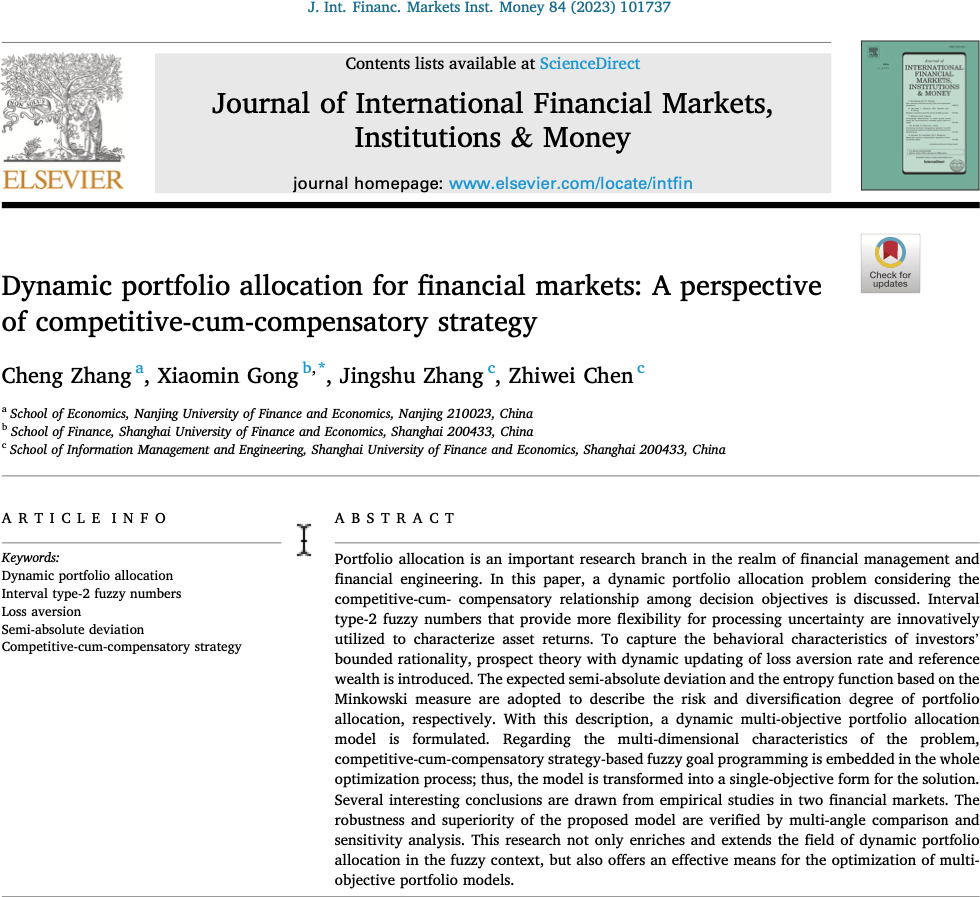
Portfolio allocation is an important research branch in the realm of financial management and financial engineering. In this paper, a dynamic portfolio allocation problem considering the competitive-cum- compensatory relationship among decision objectives is discussed. Interval type-2 fuzzy numbers that provide more flexibility for processing uncertainty are innovatively utilized to characterize asset returns. To capture the behavioral characteristics of investors’ bounded rationality, prospect theory with dynamic updating of loss aversion rate and reference wealth is introduced. The expected semi-absolute deviation and the entropy function based on the Minkowski measure are adopted to describe the risk and diversification degree of portfolio allocation, respectively. With this description, a dynamic multi-objective portfolio allocation model is formulated. Regarding the multi-dimensional characteristics of the problem, competitive-cum-compensatory strategy-based fuzzy goal programming is embedded in the whole optimization process; thus, the model is transformed into a single-objective form for the solution. Several interesting conclusions are drawn from empirical studies in two financial markets. The robustness and superiority of the proposed model are verified by multi-angle comparison and sensitivity analysis. This research not only enriches and extends the field of dynamic portfolio allocation in the fuzzy context, but also offers an effective means for the optimization of multi-objective portfolio models.


(版权归金融学院所有,转载请注明出处。)