
近期,我院许陈杰教授与合作者的论文 Asset pricing with a financial sector 发表在我校认定的国际A级期刊 Financial Management(简称FM)上。在线资源请点击“阅读原文”获取链接。
Asset pricing with a financial sector
Kai Li , Chenjie Xu
Financial Managemengt, publishied.
Financial Managemengt
Financial Management(FM)为国际金融管理协会(FMA)的旗舰季刊,是财务管理领域的顶尖期刊,也是金融研究和商业惯例领域具有显著影响、高质量的研究刊物。最近五年影响因子为3.632。

许陈杰
许陈杰
上海财经大学金融学院助理教授,硕士生导师。论文曾多次入选国内外顶级金融学年会(如AFA,CICF等)。其主要研究领域为宏观金融、资产定价。
在这个模型中,金融中介是资产的边际投资者,面临着杠杆约束。在这种设定下,金融中介的股权资本将通过一种动态反馈机制影响资产价格:对资产价格的负面冲击将降低金融中介的股权资本及其融资能力,从而减少风险资产的需求,使得资产价格进一步下跌。
在定量方面,尽管外生的消费增长过程是独立且相同分布的,该模型通过其内在反馈机制生成高均值且逆周期的股票溢价、低均值且平稳的无风险利率以及顺周期且持久的价格股息率。与其他模型不同,该金融中介模型预测,当金融中介受到杠杆约束时,银行间利率和家庭贷款利率之间的利差将会飙升。此模型预测与数据中高TED利差往往伴随着低股价和高股价波动率的经验证据相吻合。
相较于现有模型,带有金融中介的资产定价模型在定价方面的成功更加透明。在现有的模型中,习惯形成模型(habit model)的成功依赖于很高的有效风险厌恶系数,长期风险模型(long-run risks model)和灾难性风险模型(rare disaster model)的成功依赖于非经济周期的风险更容易使用可观测变量进行校准。这些变量难以在数据中估计。相比之下,金融中介变量相对更容易观测,因此也更容易使用实证数据对模型进行校准,从而提高其可证伪性。
Asset pricing with a financial sector
Kai Li , Chenjie Xu
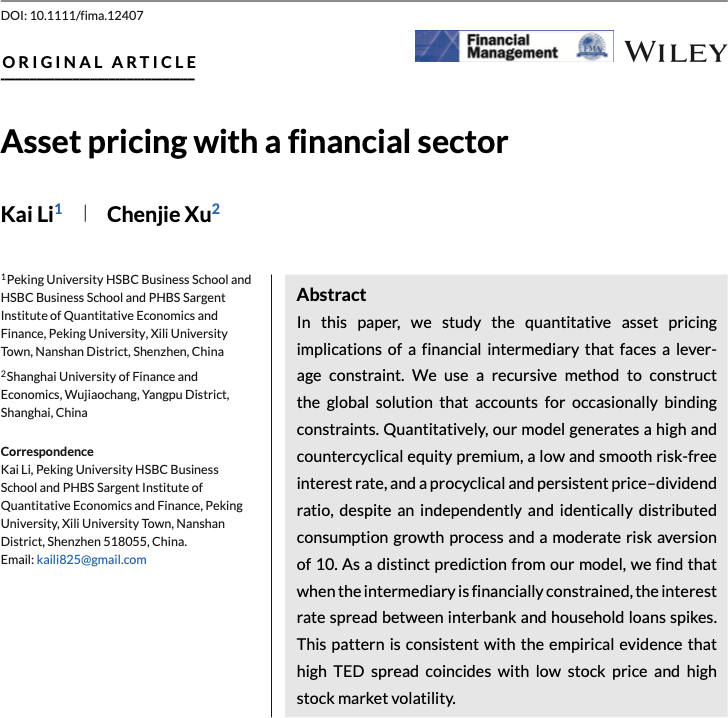
In this paper, we study the quantitative asset pricing implications of a financial intermediary that faces a lever-age constraint. We use a recursive method to construct the global solution that accounts for occasionally binding constraints. Quantitatively, our model generates a high and countercyclical equity premium, a low and smooth risk-free interest rate, and a procyclical and persistent price–dividend ratio, despite an independently and identically distributed consumption growth process and a moderate risk aversion of 10. As a distinct prediction from our model, we find that when the intermediary is financially constrained, the interest rate spread between interbank and household loans spikes. This pattern is consistent with the empirical evidence that high TED spread coincides with low stock price and high stock market volatility.


(版权归金融学院所有,转载请注明出处。)